Shop : Details
Shop
Details
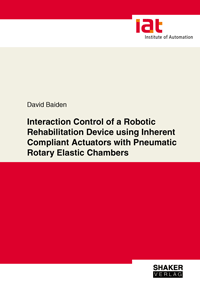

49,80 €ISBN 978-3-8440-7741-4Paperback284 Seiten162 Abbildungen422 g21 x 14,8 cmEnglischDissertation
Dezember 2020
David Baiden
Interaction Control of a Robotic Rehabilitation Device using Inherent Compliant Actuators with Pneumatic Rotary Elastic Chambers
Modern rehabilitation robots should operate close to a human and get in direct physical contact, which requires appropriate controllers. This thesis describes different interaction control concepts for an exoskeleton robot with compliant actuators on the basis of pneumatic direct drives with Rotary Elastic Chambers (REC). It is investigated which kind of interaction or effect can be achieved, if the complexity of plant models and control structures is kept as low as possible.
The first part treats modeling of the REC actuators by using experimental & phenomenological approaches. The actuator model is divided into pneumatic and mechanic subsystems and static torque characteristics are combined with different friction compensation models. A solution to independently adjust the output torque and joint rigidity is implemented.
The second part focuses on interaction controllers that manage without force sensors. For this purpose, a planar 3 degrees of freedom exoskeleton robot equipped with REC actuators is used, which can partly support the lower extremities of a person. As application example an activity of daily living is chosen, in which elderly people or slightly physically restricted stroke patients should perform repetitive sit-to-stand (StS) exercises.
The goal is to combine REC actuators and supportive controllers to facilitate the StS process, such that the user is not passively guided along a fixed trajectory, but is mostly self-determined with own authority.
The presented concepts begin from a master-slave approach with individual trajectory generation, to the usage of active virtual joint admittances through the realization of variable passive joint rigidity. An adaptive iterative learning concept eventually allows temporal and spatial freedom of movement.
The first part treats modeling of the REC actuators by using experimental & phenomenological approaches. The actuator model is divided into pneumatic and mechanic subsystems and static torque characteristics are combined with different friction compensation models. A solution to independently adjust the output torque and joint rigidity is implemented.
The second part focuses on interaction controllers that manage without force sensors. For this purpose, a planar 3 degrees of freedom exoskeleton robot equipped with REC actuators is used, which can partly support the lower extremities of a person. As application example an activity of daily living is chosen, in which elderly people or slightly physically restricted stroke patients should perform repetitive sit-to-stand (StS) exercises.
The goal is to combine REC actuators and supportive controllers to facilitate the StS process, such that the user is not passively guided along a fixed trajectory, but is mostly self-determined with own authority.
The presented concepts begin from a master-slave approach with individual trajectory generation, to the usage of active virtual joint admittances through the realization of variable passive joint rigidity. An adaptive iterative learning concept eventually allows temporal and spatial freedom of movement.
Schlagwörter: Human-robot interaction; rehabilitation robotics; supportive control; soft-actuators
Publication Series of the Institute of Automation, University of Bremen
Herausgegeben von Prof. Dr. Axel Gräser, Bremen
Band 3.12
Verfügbare Online-Dokumente zu diesem Titel
Sie benötigen den Adobe Reader, um diese Dateien ansehen zu können. Hier erhalten Sie eine kleine Hilfe und Informationen, zum Download der PDF-Dateien.
Bitte beachten Sie, dass die Online-Dokumente nicht ausdruckbar und nicht editierbar sind.
Bitte beachten Sie auch weitere Informationen unter: Hilfe und Informationen.
Bitte beachten Sie auch weitere Informationen unter: Hilfe und Informationen.
| Dokument |  | Abstract / Kurzzusammenfassung | ||
| Dateiart |  | |||
| Kosten |  | frei | ||
| Aktion |  | Download der Datei | ||
| Dokument |  | Gesamtdokument | ||
| Dateiart | | |||
| Kosten |  | 37,35 € | ||
| Aktion |  | Zahlungspflichtig kaufen und download der Datei | ||
| Dokument |  | Inhaltsverzeichnis | ||
| Dateiart | | |||
| Kosten | | frei | ||
| Aktion | | Download der Datei | ||
Benutzereinstellungen für registrierte Online-Kunden (Online-Dokumente)
Sie können hier Ihre Adressdaten ändern sowie bereits georderte Dokumente erneut aufrufen.
Benutzer
Nicht angemeldet
Export bibliographischer Daten
Shaker Verlag GmbH
Am Langen Graben 15a
52353 Düren
Am Langen Graben 15a
52353 Düren
Mo. - Do. 8:00 Uhr bis 16:00 Uhr
Fr. 8:00 Uhr bis 15:00 Uhr
Fr. 8:00 Uhr bis 15:00 Uhr
Kontaktieren Sie uns. Wir helfen Ihnen gerne weiter.