Shop : Details
Shop
Details
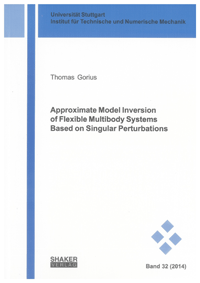
August 2014
Thomas Gorius
Approximate Model Inversion of Flexible Multibody Systems Based on Singular Perturbations
The design of a tracking control is a frequent task in applications. Thereby, the output of the system, which often represents the end-effector of a mechanism, should track a prescribed trajectory. For this purpose, a control structure with two degrees of freedom consisting of both feedforward and feedback control is widely used. The feedforward control signal is calculated from the inverse model of the nominal dynamics of the system. If the mathematical model of the real mechanism is sufficiently accurate, the feedforward control makes the output to nearly match its reference. The remaining small deviations due ot model uncertainties and disturbances are then handled by additional feedback control. Having an inverse model of a system may considerably simplify the design of the closed loop.
While rigid multibody systems representing very stiff mechanical systems can be inverted comparatively easy by applying computed torque, the calculation of the inverse model is challenging if the multibody system is subject to structural flexibilities. Inverse models of flexible multibody systems can be obtained numerically using iterative solvers. Those computations needs the reference trajectory to be known in advance such that the feedforward control signal is calculated offline.
If the flexibilities of the involved bodies are sufficiently small, then the flexible multibody system can be seen as a small perturbation of the corresponding rigid system which is reproduced by formally setting the flexibilities to zero. In this way, the equations of motion of the flexible multibody system are written as singularly perturbed differential equations where the singular perturbation parameter represents the overall flexibility of the bodies. Applying the theory of integral manifolds, a reduced model of the flexible mechanism can be obtained which allows to exactly invert the flexible dynamics by standard computed torque. However, since this reduced flexible model can in general not be obtained analytically, an approximation is calculated by asymptotic analysis. Thereby, the dynamics of the flexible multibody system is written as an asymptotic power series expansion in terms of the overall flexibility of the bodies. The expansion is truncated after a particular number of terms. The accuracy of those models is certainly dependent on the order of approximation. Like rigid multibody systems, those approximate models can be simply inverted by computed torque although they approximately incorporate the flexibility of the system. However, the computation of high-order approximations is involved.
In this thesis, approximate model inversion of flexible multibody systems based on their singularly perturbed form is presented. The obtained feedforward control signal makes the end-effector of a flexible mechanism to not exactly but approximately track a given reference. The control signal is computed as a series expansion in terms of the overall flexibility of the bodies. The solution is obtained semi-analytically, i.e. both symbolic and numeric operations are used. The expensive symbolic manipulations are independent of the actual shape of the reference trajectory and do not have to be rerun if the desired motion of the end-effector is modified. The reference trajectory does not have to be known in advance. Depending on the remaining numerical calculations, the feedforward control can be calculated in real-time.
The effort for calculating the approximate models drastically increases with the order of approximation. To handle complex multibody systems, the procedure is formalized by using linear (differential) operators such that an automatic generation of high-order approximations can be performed. Techniques to reduce the computational costs are explained in detail.
By several simulations of simple and more advanced flexible multibody systems, it is demonstrated that the tracking performance can be significantly improved by applying approximations of high-order. The feedforward-control concept is shown to be real-time capable for many practical applications.
While rigid multibody systems representing very stiff mechanical systems can be inverted comparatively easy by applying computed torque, the calculation of the inverse model is challenging if the multibody system is subject to structural flexibilities. Inverse models of flexible multibody systems can be obtained numerically using iterative solvers. Those computations needs the reference trajectory to be known in advance such that the feedforward control signal is calculated offline.
If the flexibilities of the involved bodies are sufficiently small, then the flexible multibody system can be seen as a small perturbation of the corresponding rigid system which is reproduced by formally setting the flexibilities to zero. In this way, the equations of motion of the flexible multibody system are written as singularly perturbed differential equations where the singular perturbation parameter represents the overall flexibility of the bodies. Applying the theory of integral manifolds, a reduced model of the flexible mechanism can be obtained which allows to exactly invert the flexible dynamics by standard computed torque. However, since this reduced flexible model can in general not be obtained analytically, an approximation is calculated by asymptotic analysis. Thereby, the dynamics of the flexible multibody system is written as an asymptotic power series expansion in terms of the overall flexibility of the bodies. The expansion is truncated after a particular number of terms. The accuracy of those models is certainly dependent on the order of approximation. Like rigid multibody systems, those approximate models can be simply inverted by computed torque although they approximately incorporate the flexibility of the system. However, the computation of high-order approximations is involved.
In this thesis, approximate model inversion of flexible multibody systems based on their singularly perturbed form is presented. The obtained feedforward control signal makes the end-effector of a flexible mechanism to not exactly but approximately track a given reference. The control signal is computed as a series expansion in terms of the overall flexibility of the bodies. The solution is obtained semi-analytically, i.e. both symbolic and numeric operations are used. The expensive symbolic manipulations are independent of the actual shape of the reference trajectory and do not have to be rerun if the desired motion of the end-effector is modified. The reference trajectory does not have to be known in advance. Depending on the remaining numerical calculations, the feedforward control can be calculated in real-time.
The effort for calculating the approximate models drastically increases with the order of approximation. To handle complex multibody systems, the procedure is formalized by using linear (differential) operators such that an automatic generation of high-order approximations can be performed. Techniques to reduce the computational costs are explained in detail.
By several simulations of simple and more advanced flexible multibody systems, it is demonstrated that the tracking performance can be significantly improved by applying approximations of high-order. The feedforward-control concept is shown to be real-time capable for many practical applications.
Schlagwörter: singular perturbations; flexible multibody systems; feedforward control; model inversion; inverse model
Schriften aus dem Institut für Technische und Numerische Mechanik der Universität Stuttgart
Herausgegeben von Prof. Dr.-Ing. Peter Eberhard, Stuttgart
Band 2014,32
Verfügbare Online-Dokumente zu diesem Titel
Sie benötigen den Adobe Reader, um diese Dateien ansehen zu können. Hier erhalten Sie eine kleine Hilfe und Informationen, zum Download der PDF-Dateien.
Bitte beachten Sie, dass die Online-Dokumente nicht ausdruckbar und nicht editierbar sind.
Bitte beachten Sie auch weitere Informationen unter: Hilfe und Informationen.
Bitte beachten Sie auch weitere Informationen unter: Hilfe und Informationen.
| Dokument |  | Gesamtdokument | ||
| Dateiart |  | |||
| Kosten |  | 36,60 € | ||
| Aktion |  | Zahlungspflichtig kaufen und download der Datei | ||
| Dokument |  | Inhaltsverzeichnis | ||
| Dateiart | | |||
| Kosten |  | frei | ||
| Aktion |  | Download der Datei | ||
| Dokument |  | Abstract / Kurzzusammenfassung | ||
| Dateiart | | |||
| Kosten | | frei | ||
| Aktion | | Download der Datei | ||
Benutzereinstellungen für registrierte Online-Kunden (Online-Dokumente)
Sie können hier Ihre Adressdaten ändern sowie bereits georderte Dokumente erneut aufrufen.
Benutzer
Nicht angemeldet
Export bibliographischer Daten
Shaker Verlag GmbH
Am Langen Graben 15a
52353 Düren
Am Langen Graben 15a
52353 Düren
Mo. - Do. 8:00 Uhr bis 16:00 Uhr
Fr. 8:00 Uhr bis 15:00 Uhr
Fr. 8:00 Uhr bis 15:00 Uhr
Kontaktieren Sie uns. Wir helfen Ihnen gerne weiter.