Shop : Details
Shop
Details
Mai 2013
Angelika Rosemarie Hirsch
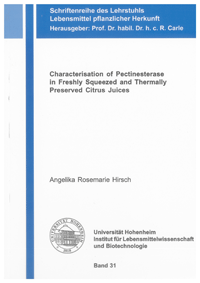
Characterisation of Pectinesterase in Freshly Squeezed and Thermally Preserved Citrus Juices
The aim of this study was to identify a specific indicator of freshness, allowing routine distinction between freshly squeezed Citrus juices (FSCJs) and FSCJ-like products having undergone mild pasteurisation, based on the quantification of the native enzyme activities pectin methylesterase (PE) and peroxidase (POD).
For the validation of the determination methods, enzyme activities were reduced by thermal treatment. Heat treatment was performed using the Actijoule unit of a tubular heater at a flow rate of 60 L/h. Freshly squeezed orange juices (FSOJs) were continuously heated on a pilot plant scale at six different temperatures (42-92 °C) for a residence time of 12 s, followed by countercurrent flow cooling to ambient temperature using tap water. The cloud stability and residual activities of PE and POD were monitored at 4 °C over a storage up to 62 days. Microbial activity was insignificant due to good hygienic practice, thus ensuring that the enzyme activities detected were of fruit origin. The juices processed at temperatures >= 62 °C were characterized by minor residual activities. When exposed to temperatures < 62 °C in the genuine acidic matrix of the juices, heat stability of PE exceeded that of POD. Hence, only the range of approx. 50-60 °C is relevant in minimal heat-processing for the retention of cloud stability within the short turnover period of FSOJ-like products, with partial PE and POD deactivation being already sufficient to distinguish heat treated juices from FSOJs. Irrespective of the previous thermal treatment, total PE activity remained nearly constant during storage, whereas POD activity rapidly declined to minor levels after 20 days.
In order to survey the native enzyme activities in different Citrus fruits, the impact of minimal heat-processing of juices on the activities of endogenous PE and POD was compared between Citrus species. Therefore, mono-cultivar juices from three orange, two lemon, two Clementine mandarin varieties, and two mandarin hybrids were included in the study. The freshly squeezed juices were subjected to continuous thermal treatments at six different temperatures (42-92 °C) with subsequent re-cooling on a pilot plant scale. In fresh Citrus juice, POD activities notably varied, whereas PE activities were more uniform. In all juices, except the juice from cv. ‘Ortanique’, heating above 42 °C for 12 s reduced POD activity below 4.3 % of the maximum activity in fresh Citrus juice. Thermal tolerance of the thermolabile PE fraction was overall much higher than that of POD, but varied among juices during heating at temperatures <= 62 °C. Overall thermal resistance of PE was though comparable, with deactivation exceeding 84 %, mostly even 90 %, after thermal treatments >= 72 °C. Unlike POD, total PE activity proved to be an indicator of freshness with universal applicability to Citrus juices derived from orange, mandarin, and lemon or blends thereof. Freshly squeezed juices can analytically be distinguished from cold-stored, minimally processed products that dispose of an almost completely inactivated thermo-labile PE fraction, and thus extended shelf life.
The method developed for freshness authentication of FSCJs was evaluated for routine application. Standard test conditions allowed reliable discrimination between FSCJ and chilled Citrus juices that had comparative advantages due to their longer shelf life. Accuracy was substantiated by 100-106 % recovery for model juices with PE activities of 0.87- 1.22 units g-1 resulting from FSCJ dilution or PE standard addition (spiking). The average of the mean activities determined by 3 analysts with intra-assay precision <= 8.4 proved reproducibility of the method. FSCJ batches were unambiguously distinguished from four commercial chilled juices, because the activities detected for the latter were by far below the limit of detection (LOD), and thus confirmed mild preservation as indicated by labelling.
Consequently, regarding analyses of samples with unknown processing history, PE was suggested as an indicator enzyme for the freshness of FSCJs, allowing their unambiguous distinction from minimally heat-processed juices.
For the validation of the determination methods, enzyme activities were reduced by thermal treatment. Heat treatment was performed using the Actijoule unit of a tubular heater at a flow rate of 60 L/h. Freshly squeezed orange juices (FSOJs) were continuously heated on a pilot plant scale at six different temperatures (42-92 °C) for a residence time of 12 s, followed by countercurrent flow cooling to ambient temperature using tap water. The cloud stability and residual activities of PE and POD were monitored at 4 °C over a storage up to 62 days. Microbial activity was insignificant due to good hygienic practice, thus ensuring that the enzyme activities detected were of fruit origin. The juices processed at temperatures >= 62 °C were characterized by minor residual activities. When exposed to temperatures < 62 °C in the genuine acidic matrix of the juices, heat stability of PE exceeded that of POD. Hence, only the range of approx. 50-60 °C is relevant in minimal heat-processing for the retention of cloud stability within the short turnover period of FSOJ-like products, with partial PE and POD deactivation being already sufficient to distinguish heat treated juices from FSOJs. Irrespective of the previous thermal treatment, total PE activity remained nearly constant during storage, whereas POD activity rapidly declined to minor levels after 20 days.
In order to survey the native enzyme activities in different Citrus fruits, the impact of minimal heat-processing of juices on the activities of endogenous PE and POD was compared between Citrus species. Therefore, mono-cultivar juices from three orange, two lemon, two Clementine mandarin varieties, and two mandarin hybrids were included in the study. The freshly squeezed juices were subjected to continuous thermal treatments at six different temperatures (42-92 °C) with subsequent re-cooling on a pilot plant scale. In fresh Citrus juice, POD activities notably varied, whereas PE activities were more uniform. In all juices, except the juice from cv. ‘Ortanique’, heating above 42 °C for 12 s reduced POD activity below 4.3 % of the maximum activity in fresh Citrus juice. Thermal tolerance of the thermolabile PE fraction was overall much higher than that of POD, but varied among juices during heating at temperatures <= 62 °C. Overall thermal resistance of PE was though comparable, with deactivation exceeding 84 %, mostly even 90 %, after thermal treatments >= 72 °C. Unlike POD, total PE activity proved to be an indicator of freshness with universal applicability to Citrus juices derived from orange, mandarin, and lemon or blends thereof. Freshly squeezed juices can analytically be distinguished from cold-stored, minimally processed products that dispose of an almost completely inactivated thermo-labile PE fraction, and thus extended shelf life.
The method developed for freshness authentication of FSCJs was evaluated for routine application. Standard test conditions allowed reliable discrimination between FSCJ and chilled Citrus juices that had comparative advantages due to their longer shelf life. Accuracy was substantiated by 100-106 % recovery for model juices with PE activities of 0.87- 1.22 units g-1 resulting from FSCJ dilution or PE standard addition (spiking). The average of the mean activities determined by 3 analysts with intra-assay precision <= 8.4 proved reproducibility of the method. FSCJ batches were unambiguously distinguished from four commercial chilled juices, because the activities detected for the latter were by far below the limit of detection (LOD), and thus confirmed mild preservation as indicated by labelling.
Consequently, regarding analyses of samples with unknown processing history, PE was suggested as an indicator enzyme for the freshness of FSCJs, allowing their unambiguous distinction from minimally heat-processed juices.
Schlagwörter: pectin methylesterase; peroxidase activity; thermal treatments; heat-processing; freshly squeezed Citrus juices; pectin methylesterase activity quantitation
Schriftenreihe des Lehrstuhls Lebensmittel pflanzlicher Herkunft
Herausgegeben von Prof. Dr. habil. Dr. h. c. Reinhold Carle, Stuttgart
Band 2013,31
Verfügbare Online-Dokumente zu diesem Titel
Sie benötigen den Adobe Reader, um diese Dateien ansehen zu können. Hier erhalten Sie eine kleine Hilfe und Informationen, zum Download der PDF-Dateien.
Bitte beachten Sie, dass die Online-Dokumente nicht ausdruckbar und nicht editierbar sind.
Bitte beachten Sie auch weitere Informationen unter: Hilfe und Informationen.
Bitte beachten Sie auch weitere Informationen unter: Hilfe und Informationen.
| Dokument |  | Gesamtdokument | ||
| Dateiart |  | |||
| Kosten |  | 23,10 € | ||
| Aktion |  | Zahlungspflichtig kaufen und download der Datei | ||
| Dokument |  | Inhaltsverzeichnis | ||
| Dateiart | | |||
| Kosten |  | frei | ||
| Aktion |  | Download der Datei | ||
| Dokument |  | Abstract / Kurzzusammenfassung | ||
| Dateiart | | |||
| Kosten | | frei | ||
| Aktion | | Download der Datei | ||
Benutzereinstellungen für registrierte Online-Kunden (Online-Dokumente)
Sie können hier Ihre Adressdaten ändern sowie bereits georderte Dokumente erneut aufrufen.
Benutzer
Nicht angemeldet
Export bibliographischer Daten
Shaker Verlag GmbH
Am Langen Graben 15a
52353 Düren
Am Langen Graben 15a
52353 Düren
Mo. - Do. 8:00 Uhr bis 16:00 Uhr
Fr. 8:00 Uhr bis 15:00 Uhr
Fr. 8:00 Uhr bis 15:00 Uhr
Kontaktieren Sie uns. Wir helfen Ihnen gerne weiter.