Shop : Details
Shop
Details
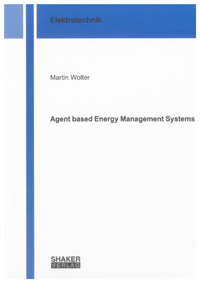
November 2012
Martin Wolter
Agent based Energy Management Systems
In liberalized, regulated energy markets, the different participants – namely producers and consumers of energy, transmission and distribution system operators as well as regulatory authorities – have partly divergent and partly convergent interests. Loads, power plants and grid operators try to maximize their own benefit in this highly complex environment accepting to act detrimentally to others.
Although the relationship between the participants is mostly competitive, there are some fundamental shared interests, e.g. voltage stability, a constant system frequency or efficient energy production, transmission and distribution, which are endangered e.g. by increased injection of volatile sources in low and medium voltage grids, displacement of stabilizing bulk generation and the slowly progressing extension of the electric grid.
There is a global consensus, that the resulting challenges can efficiently be faced using information and communication technologies to coordinate grid utilization and operation. The basic idea is to benefit from unused reserves by participating in deployment of system services e.g. reactive power supply to keep the voltage within certain bounds. The coordination can best be done by the grid operator. All activities of that kind are summarized under the umbrella term “Smart Grid”.
To simultaneously model the behavior and interests of different types of market participants and their convergent and divergent interests, multi-agent systems are used. They offer a perfectly fitting framework for this sort of game theory and can easily be adapted to all kinds of new challenges of electricity markets.
In this work, multi-agent systems are used to either cooperatively or competitively solve problems in distribution and transmission systems. Therefore, conventional algorithms have to be modified to converge into multiple local optima using only small pieces of the entire system information. It is clearly stated, that personal benefits can be maximized without violating global requirements on the system. Therefore, coordination of the measures is necessary. This can be done decentrally by the agents as well.
Although the relationship between the participants is mostly competitive, there are some fundamental shared interests, e.g. voltage stability, a constant system frequency or efficient energy production, transmission and distribution, which are endangered e.g. by increased injection of volatile sources in low and medium voltage grids, displacement of stabilizing bulk generation and the slowly progressing extension of the electric grid.
There is a global consensus, that the resulting challenges can efficiently be faced using information and communication technologies to coordinate grid utilization and operation. The basic idea is to benefit from unused reserves by participating in deployment of system services e.g. reactive power supply to keep the voltage within certain bounds. The coordination can best be done by the grid operator. All activities of that kind are summarized under the umbrella term “Smart Grid”.
To simultaneously model the behavior and interests of different types of market participants and their convergent and divergent interests, multi-agent systems are used. They offer a perfectly fitting framework for this sort of game theory and can easily be adapted to all kinds of new challenges of electricity markets.
In this work, multi-agent systems are used to either cooperatively or competitively solve problems in distribution and transmission systems. Therefore, conventional algorithms have to be modified to converge into multiple local optima using only small pieces of the entire system information. It is clearly stated, that personal benefits can be maximized without violating global requirements on the system. Therefore, coordination of the measures is necessary. This can be done decentrally by the agents as well.
Verfügbare Online-Dokumente zu diesem Titel
Sie benötigen den Adobe Reader, um diese Dateien ansehen zu können. Hier erhalten Sie eine kleine Hilfe und Informationen, zum Download der PDF-Dateien.
Bitte beachten Sie, dass die Online-Dokumente nicht ausdruckbar und nicht editierbar sind.
Bitte beachten Sie auch weitere Informationen unter: Hilfe und Informationen.
Bitte beachten Sie auch weitere Informationen unter: Hilfe und Informationen.
| Dokument |  | Gesamtdokument | ||
| Dateiart |  | |||
| Kosten |  | 34,35 € | ||
| Aktion |  | Zahlungspflichtig kaufen und download der Datei | ||
| Dokument |  | Inhaltsverzeichnis | ||
| Dateiart | | |||
| Kosten |  | frei | ||
| Aktion |  | Download der Datei | ||
Benutzereinstellungen für registrierte Online-Kunden (Online-Dokumente)
Sie können hier Ihre Adressdaten ändern sowie bereits georderte Dokumente erneut aufrufen.
Benutzer
Nicht angemeldet
Export bibliographischer Daten
Shaker Verlag GmbH
Am Langen Graben 15a
52353 Düren
Am Langen Graben 15a
52353 Düren
Mo. - Do. 8:00 Uhr bis 16:00 Uhr
Fr. 8:00 Uhr bis 15:00 Uhr
Fr. 8:00 Uhr bis 15:00 Uhr
Kontaktieren Sie uns. Wir helfen Ihnen gerne weiter.