Shop : Details
Shop
Details
April 2011
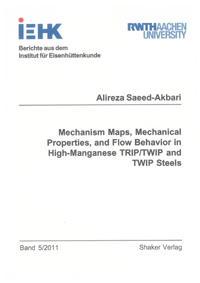
Alireza Saeed-Akbari
Mechanism Maps, Mechanical Properties, and Flow Behavior in High-Manganese TRIP/TWIP and TWIP Steels
The systematic development and application of mechanism maps for high-manganese steels on the basis of thermodynamic calculations was the initial goal of current investigation. By using the available datasets, variety of composition- and temperature-dependent maps for controlling the deformation mechanisms in TRIP/TWIP and TWIP systems were developed. The stacking fault energy, the change of Gibbs free energy due to TRIP mechanism with its chemical and magnetic contributions, and finally the composition-dependent equilibrium temperature for TRIP effect, were calculated and integrated in the mechanism maps. The consistency of the thermodynamically predicted mechanisms was both compared with the published data in the literature, and with the laboratory produced high-manganese steels in the Fe-Mn-C system. The observed changes in the resultant mechanical properties were explained according to the as-received microstructures, the activated plasticity mechanisms, the deformation parameters, and the interstitial and substitutional alloying contents. In addition, variations in the flow behavior of high-manganese TWIP steels within Fe-Mn-C and Fe-Mn-Al-C systems were studied by consideration of the effects of temperature, strain-rate, and grain-size-distribution. The cooperative application of three derivatives of flow curve data namely, work-hardening-rate, strain-rate-sensitivity, and instantaneous strain rate, was shown to be able to efficiently explain the occurrence of serrated and smooth plastic flow in these steels. The increase of stacking fault energy by increasing the deformation temperature and the applied strain rate, together with the strong grain-size-dependency of deformation twinning were among the most important defining parameters for the strain-hardening behavior of TWIP steels. In addition, the established roles of carbon and aluminum on changing the twins' internal structure and twins' morphology were reviewed and compared with the experimental results of the present work. Specifically, the interconnected influence of deformation twinning and dynamic strain aging on the evolution of serrated plastic flow was discussed. It was found that a proper application of thermodynamics-based mechanisms maps, together with the gathered knowledge in terms of the dependency of flow behavior on the deformation parameters, is a true strategy for tailored materials design in high-manganese steels' systems.
Schlagwörter: Mechanism Maps; TRIP/TWIP; Twinning; Microstructure; Gibbs Free Energy; Flow Behavior; Portevin Le-Chatelier Effect; Serrated Flow; Thermography; EBSD; TEM; T0
Berichte aus dem Institut für Eisenhüttenkunde
Herausgegeben von Prof. Dr.-Ing. W. Bleck, Prof. Dr.-Ing. U. Krupp, Prof. Dr.-Ing. S. Münstermann und Prof. Dr.-Ing. D. Senk, Aachen
Band 2011,5
Verfügbare Online-Dokumente zu diesem Titel
Sie benötigen den Adobe Reader, um diese Dateien ansehen zu können. Hier erhalten Sie eine kleine Hilfe und Informationen, zum Download der PDF-Dateien.
Bitte beachten Sie, dass die Online-Dokumente nicht ausdruckbar und nicht editierbar sind.
Bitte beachten Sie auch weitere Informationen unter: Hilfe und Informationen.
Bitte beachten Sie auch weitere Informationen unter: Hilfe und Informationen.
| Dokument |  | Abstract / Kurzzusammenfassung | ||
| Dateiart |  | |||
| Kosten |  | frei | ||
| Aktion |  | Download der Datei | ||
| Dokument |  | Gesamtdokument | ||
| Dateiart | | |||
| Kosten |  | 37,35 € | ||
| Aktion |  | Zahlungspflichtig kaufen und download der Datei | ||
| Dokument |  | Inhaltsverzeichnis | ||
| Dateiart | | |||
| Kosten | | frei | ||
| Aktion | | Download der Datei | ||
Benutzereinstellungen für registrierte Online-Kunden (Online-Dokumente)
Sie können hier Ihre Adressdaten ändern sowie bereits georderte Dokumente erneut aufrufen.
Benutzer
Nicht angemeldet
Export bibliographischer Daten
Shaker Verlag GmbH
Am Langen Graben 15a
52353 Düren
Am Langen Graben 15a
52353 Düren
Mo. - Do. 8:00 Uhr bis 16:00 Uhr
Fr. 8:00 Uhr bis 15:00 Uhr
Fr. 8:00 Uhr bis 15:00 Uhr
Kontaktieren Sie uns. Wir helfen Ihnen gerne weiter.