Shop : Details
Shop
Details
Dezember 2014
Sarina M. Duckstein
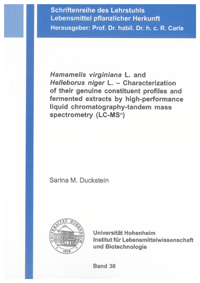
Hamamelis virginiana L. and Helleborus niger L. – Characterization of their genuine constituent profiles and fermented extracts by high-performance liquid chromatography-tandem mass spectrometry (LC-MSn)
The plants Hamamelis virginiana L. and Helleborus niger L. are both used for pharmaceutical purposes with a long traditional use in folk medicine. Surprisingly, up to date, the constituents of these plants are only poorly characterized. In complementary medicine, fermented extracts prepared from H. virginiana and H. niger according to the German Homoeopathic Pharmacopoeia (GHP) are used for pharmaceutical purposes, but the knowledge about the influence of the fermentation process on their secondary metabolites is mostly unknown. Therefore, the intention of the recent thesis was a detailed analytical study to uncover the corresponding secondary metabolite spectra of H. virginiana leaves and in the aerial parts as well as the roots from H. niger. Furthermore, the conversion of these constituents was monitored for 6 months during processing according to the GHP. By HPLC-DAD and LC-MSn, the secondary metabolites in H. virginiana were identified as 27 phenolic compounds of the groups hydroxycinnamic acid derivatives, flavonol glycosides and tannins. During fermentation of H. virginiana leaf extracts, hydroxycinnamic acids remained stable. The flavonol glycosides and gallotannins were both transformed to low molecular weight substances. The secondary metabolites of H niger leaves were 15 acylated flavonol glycosides, ranunculin derivatives, beta-ecdysone and 19 steroidal sapoinins. The roots contained two subgroups of altogether 38 steroidal saponins: diosgenyl-type saponins and acetylated polyhydroxysaponins. During fermentation diosgenyl-type saponins were successively deglycosylated. The acetylated polyhydroxysaponins lost their acetyl groups, but were further cleaved only in parts.
Schlagwörter: Hamamelis; Hamamelidaceae; phenolics; gallotannins; flavonol glycosides; hydroxycinnamic acid derivatives; stability; HPLC-DAD; LC-MS; GC-MS; NMR; fermentation; Helleborus; Ranunculaceae; saponins; acetylated polyhydroxysaponins; acylated flavonols
Schriftenreihe des Lehrstuhls Lebensmittel pflanzlicher Herkunft
Herausgegeben von Prof. Dr. habil. Dr. h. c. Reinhold Carle, Stuttgart
Band 2014,38
Verfügbare Online-Dokumente zu diesem Titel
Sie benötigen den Adobe Reader, um diese Dateien ansehen zu können. Hier erhalten Sie eine kleine Hilfe und Informationen, zum Download der PDF-Dateien.
Bitte beachten Sie, dass die Online-Dokumente nicht ausdruckbar und nicht editierbar sind.
Bitte beachten Sie auch weitere Informationen unter: Hilfe und Informationen.
| Dokument |  | Abstract / Kurzzusammenfassung | ||
| Dateiart |  | |||
| Kosten |  | frei | ||
| Aktion |  | Download der Datei | ||
| Dokument |  | Gesamtdokument | ||
| Dateiart | | |||
| Kosten |  | 26,85 € | ||
| Aktion |  | Zahlungspflichtig kaufen und download der Datei | ||
| Dokument |  | Inhaltsverzeichnis | ||
| Dateiart | | |||
| Kosten | | frei | ||
| Aktion | | Download der Datei | ||
Benutzereinstellungen für registrierte Online-Kunden (Online-Dokumente)
Sie können hier Ihre Adressdaten ändern sowie bereits georderte Dokumente erneut aufrufen.
Benutzer
Nicht angemeldet
Export bibliographischer Daten
Shaker Verlag GmbH
Am Langen Graben 15a
52353 Düren
Mo. - Do. 8:00 Uhr bis 16:00 Uhr
Fr. 8:00 Uhr bis 15:00 Uhr
Kontaktieren Sie uns. Wir helfen Ihnen gerne weiter.