Shop : Details
Shop
Details
März 2012
Michael Novak
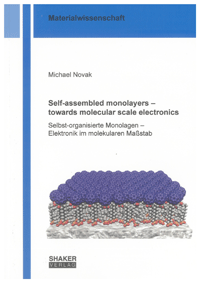
Self-assembled monolayers – towards molecular scale electronics
Selbst-organisierte Monolagen – Elektronik im molekularen Maßstab
In this work, self-assembled monolayers (SAMs) are investigated, with the aim to realize molecular scale electronics. Different phosphonic acid molecules are employed to selfassemble into multifunctional monolayers. This study focuses on the relation between the molecule design and the monolayer structure with respect to the morphology and the charge transport phenomena through and across the monolayer.
The design of the self-assembling molecules is based on a surface active group (phosphonic acid), which enables the selective deposition of a monomolecular layer. Advanced functionalities are introduced by different molecular units: An aliphatic carbon chain provides electrical isolation. An aromatic functionalization leads to semiconducting monolayers. Each part of the molecule design impacts on the formation and the molecular order as well as on the functionality of the SAM.
In the first part of this work, the molecular structure and the insulating properties of SAMs, of molecules with different chain lengths are systematically investigated. The different SAMs are applied as dielectric layer in organic thin-film transistors and capacitors, to investigate the influence of nanometer changes in the molecule design, on the device performance. In the second part, self-assembled monolayer field-effect transistors (SAM-FETs) are realized on the basis of two functionalized molecules. For p-type channel transistors a quaterthiophene unit is attached to the phosphonic acid. For n-type channel devices a C60 fullerene is chosen to form semiconducting monolayers. An important factor is the structure of the resulting functional monolayer, which directly relates to the operation of the SAM-FETs. In the third part, the obtained results are combined in a mixed SAM approach. Multifunctional molecules and isolating molecules are applied in a co-deposition process to generate mixed monolayers for SAM-FETs. Thereby, the composition of the mixed SAM is controlled by the mixture of the solution blend. The structure and molecular order of the mixed SAM is significantly improved and impact positively on the electrical properties of the monolayer. The improved electrical performance of mixed SAMs is demonstrated in corresponding SAM-FETs.
Export bibliographischer Daten
Shaker Verlag GmbH
Am Langen Graben 15a
52353 Düren
Mo. - Do. 8:00 Uhr bis 16:00 Uhr
Fr. 8:00 Uhr bis 15:00 Uhr
Kontaktieren Sie uns. Wir helfen Ihnen gerne weiter.