Shop : Details
Shop
Details
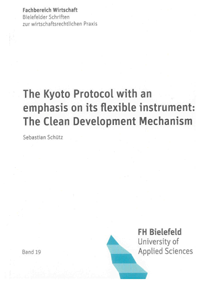
Sebastian Schütz
The Kyoto Protocol with an emphasis on its flexible instrument: The Clean Development Mechanism
This work examines and identifies the framework of international environmental law at the point of current and ongoing negotiations on a post-Kyoto treaty. Due to the non-completion of a legally binding contract at the 15th Conference of the Parties to the United Nations Framework Convention on Climate Change held in Copenhagen in December 2009 as well as the 16th Conference of the Parties held in Cancun in November/December 2010, it is within the scope of this publication to review the existing mechanisms on greenhouse gas abatement policies with an emphasis on one of the most controversial discussed instrument and the first global market mechanism in international environmental law: The Clean Development Mechanism.
The underlying economic idea of this instrument, namely to introduce and establish a tool that provides the potential of abatement measures at the most cost-efficient place throughout the entire economies of the world, is by definition an enormously appealing idea in contemplation of an unavoidable shift towards a more sustainable value creation process in the post-Kyoto era.
Since its introduction, the Clean Development Mechanism provided an investment flow throughout currently 2588 registered projects. Thus, the momentum of this mechanism has been proved by the amount of registered and already approved projects and their contribution to emission reduction during the first commitment period that will end in 2012. Yet the following questions are needed to be answered by the participating parties within a successful process to design a follow-up agreement to the Kyoto Protocol.
- First, are human development goals prior to environmental and greenhouse gas reduction targets? If this is the case, a global environmental law with legally binding emission targets for all entities will be challenging to implement.
- Second, how to ensure that carbon leakage, meaning that entities respond to emission reduction measures in one country by moving to a non-abating region or country, is not occurring.
- Third, how to achieve that all (developing-) countries gain equal shares of Clean Development Mechanism projects and by that transfer of technology and precautionary measures to adapt to global warming.
This work ought to supply impulses to assess and respond to these questions as well as it provides an objective-oriented insight into current environmental law issues.
Fachbereich Wirtschaft der FH Bielefeld, Bielefeld
Verfügbare Online-Dokumente zu diesem Titel
Bitte beachten Sie auch weitere Informationen unter: Hilfe und Informationen.
| Dokument |  | Abstract / Kurzzusammenfassung | ||
| Dateiart |  | |||
| Kosten |  | frei | ||
| Aktion |  | Download der Datei | ||
| Dokument |  | Gesamtdokument | ||
| Dateiart | | |||
| Kosten |  | 22,35 € | ||
| Aktion |  | Zahlungspflichtig kaufen und download der Datei | ||
| Dokument |  | Inhaltsverzeichnis | ||
| Dateiart | | |||
| Kosten | | frei | ||
| Aktion | | Download der Datei | ||
Am Langen Graben 15a
52353 Düren
Fr. 8:00 Uhr bis 15:00 Uhr