Shop : Details
Shop
Details
Januar 2011
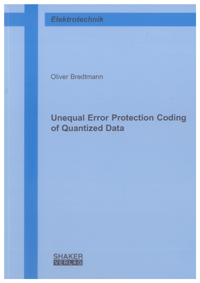
Oliver Bredtmann
Unequal Error Protection Coding of Quantized Data
A system is considered where single analog data are quantized to be transmitted over a digital communication system. Channel coding schemes are investigated that are designed to provide a low mean square error (MSE) in the analog data instead of providing large minimum distances.
In case of transmission errors, the influence of a bit error in the quantized word on the analog value is much larger when it corrupts the most sigificant bit compared to the least sigificant bit. Accordingly, a channel code should provide more protection to the foremost bits than to the backmost bits of a quantized word, more precisely, it should offer a continuous increase of protection from the last to the first bit.
In this thesis it is shown that a channel code with such properties can be obtained by truncation of a convolutional code. Usually, the convolutional encoding procedure starts in a predefined state, therefore, the decoder has a-priori information about the first states which leads to an increased protection of the foremost bits. Furthermore, the truncation of convolutional codes leads to a low protection of the backmost bits. It is shown that when truncated convolutional codes are applied on short information sequences they show the required bitwise increase of protection from the last to the first information bit. Such codes may not provide high minimum distances, instead they show a very good performance with respect to the MSE. Simulation results are presented that show that truncated convolutional codes usually have better performance than standard block codes, other linear unequal error protection block codes, and constructions of redundant index assignments.
In order to gain more control of the bitwise increase of protection, a new class of timevarying convolutional codes is developed. The unequal error protection capabilities of such codes are examined and it is shown that a huge performance gain is possible when this method is used to adapt the code to channel conditions.
Furthermore, a new approximation formula is developed which determines the MSE based on the generator matrix of a code. This approximation is used to compare the performance of codes and to determine MSE-optimal codes for several different dimensions.
Schlagwörter: Analog-digital conversion; Convolutional codes; Quantization; Unequal error protection
Verfügbare Online-Dokumente zu diesem Titel
Sie benötigen den Adobe Reader, um diese Dateien ansehen zu können. Hier erhalten Sie eine kleine Hilfe und Informationen, zum Download der PDF-Dateien.
Bitte beachten Sie, dass die Online-Dokumente nicht ausdruckbar und nicht editierbar sind.
Bitte beachten Sie auch weitere Informationen unter: Hilfe und Informationen.
| Dokument |  | Abstract / Kurzzusammenfassung | ||
| Dateiart |  | |||
| Kosten |  | frei | ||
| Aktion |  | Download der Datei | ||
| Dokument |  | Gesamtdokument | ||
| Dateiart | | |||
| Kosten |  | 34,35 € | ||
| Aktion |  | Zahlungspflichtig kaufen und download der Datei | ||
| Dokument |  | Inhaltsverzeichnis | ||
| Dateiart | | |||
| Kosten | | frei | ||
| Aktion | | Download der Datei | ||
Benutzereinstellungen für registrierte Online-Kunden (Online-Dokumente)
Sie können hier Ihre Adressdaten ändern sowie bereits georderte Dokumente erneut aufrufen.
Benutzer
Nicht angemeldet
Export bibliographischer Daten
Shaker Verlag GmbH
Am Langen Graben 15a
52353 Düren
Mo. - Do. 8:00 Uhr bis 16:00 Uhr
Fr. 8:00 Uhr bis 15:00 Uhr
Kontaktieren Sie uns. Wir helfen Ihnen gerne weiter.